
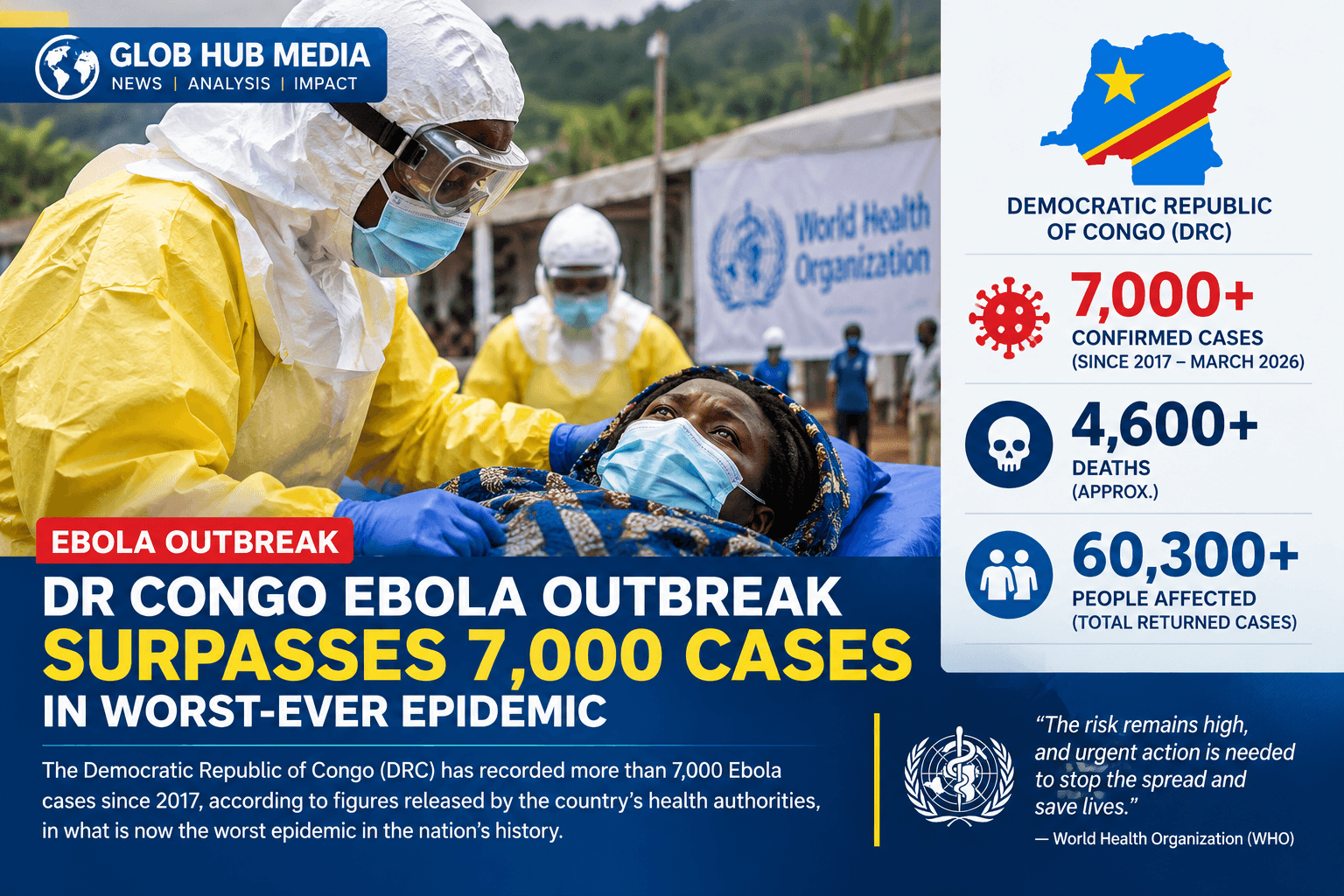
Government data show that 7,022 cases have been recorded since the outbreak was officially detected in May, while 3,398 people have died and 1,671 people have recovered.
The outbreak is being caused by the Bundibugyo strain of Ebola virus, and it has now spread across seven provinces of the Democratic Republic of Congo.
The latest development has heightened concerns among health authorities and international partners, particularly after the virus was detected in South-Ubangi province in the northwest of the country.
South-Ubangi borders the Central African Republic and the Republic of Congo, raising concerns that continued transmission could create additional challenges for neighbouring countries.
The outbreak was first officially detected in mid-May in Ituri Province in northeastern Democratic Republic of Congo.
However, health experts have warned that the virus may have been circulating in communities for several weeks before it was officially identified.
Since then, the outbreak has expanded into other areas, including regions affected by armed conflict, insecurity and weak health infrastructure.
Those conditions are making the response significantly more difficult for health workers and international organisations attempting to identify cases, trace contacts and isolate infected people.
Ituri remains the epicentre of the outbreak, with a large proportion of the reported cases concentrated there.
The disease has also been detected in other provinces, including North Kivu, South Kivu, Haut-Uele, Tshopo, Bas-Uele and now South-Ubangi.
The expansion into South-Ubangi is particularly concerning because the province is geographically separated from the main outbreak areas.
Authorities have reported a case there involving a 23-year-old man who had travelled through several areas affected by Ebola before returning to the province.
The man developed symptoms and later died, with laboratory testing confirming that he had Ebola.
Health authorities subsequently began identifying and monitoring people who had been in contact with him in an effort to prevent further transmission.
The development demonstrates the challenges facing the response, particularly in a country where people frequently travel between regions and where some communities have limited access to healthcare facilities.
Ebola is a severe and potentially fatal viral disease.
Symptoms can include fever, intense weakness, muscle pain, headache and sore throat, followed in some cases by vomiting, diarrhoea, abdominal pain and bleeding.
The virus is primarily transmitted through direct contact with the blood or other bodily fluids of an infected person, or through contact with contaminated materials.Because Ebola can spread rapidly when cases are not identified and isolated quickly, health authorities are relying heavily on surveillance, laboratory testing, contact tracing, infection prevention and community awareness.Health workers are also working to identify people who may have been exposed to infected patients and monitor them for symptoms.The response is taking place under extremely difficult circumstances.Parts of eastern and northern Democratic Republic of Congo have suffered years of armed conflict, with armed groups operating in several areas and access to some communities remaining difficult.Weak healthcare infrastructure and shortages of trained personnel are also complicating efforts to contain the outbreak.International health organisations have been supporting Congolese authorities with disease surveillance, medical care, logistics and other emergency response activities.The World Health Organization has warned that additional health workers and resources are required to strengthen the response.The scale of the current outbreak is particularly alarming because it has already surpassed the previous major Ebola epidemic in the Democratic Republic of Congo.The earlier outbreak, which took place mainly in North Kivu and Ituri between 2018 and 2020, infected around 3,500 people and killed nearly 2,300.The current outbreak has now recorded more than twice that number of cases.However, the current epidemic remains smaller than the devastating West Africa Ebola outbreak of 2014 to 2016, which affected Guinea, Liberia and Sierra Leone and recorded more than 28,000 cases and over 11,000 deaths.Despite advances in Ebola vaccines, diagnosis and treatment, the disease remains a serious public-health threat.The latest outbreak also highlights the importance of early detection.When suspected cases are identified quickly, patients can be isolated, contacts can be monitored and additional transmission chains can potentially be stopped.But where cases remain undetected, particularly in remote or insecure communities, the virus can continue spreading before health authorities become aware of new infections.Congolese health authorities are therefore urging communities to report suspected cases and cooperate with health workers.People are also being encouraged to follow public-health guidance and avoid direct contact with the bodily fluids of people who may be infected.Healthcare workers face particular risks because they are frequently in close contact with infected patients.Ensuring adequate protective equipment, infection-control procedures and training remains a critical part of the response.The outbreak is also placing additional pressure on a healthcare system that is already dealing with multiple challenges, including conflict, displacement and limited access to medical services in some parts of the country.International cooperation will therefore remain important as authorities attempt to bring the outbreak under control.For now, health officials are concentrating on identifying new cases, tracing contacts, isolating patients, providing treatment and preventing the virus from reaching additional communities and neighbouring countries.The latest figures show that the outbreak has become the largest Ebola epidemic ever recorded in the Democratic Republic of Congo.With 7,022 confirmed cases and 3,398 deaths reported so far, the scale of the crisis has raised renewed concerns about the ability of health authorities to contain the virus in areas where insecurity and limited healthcare access continue to present major obstacles.The situation remains closely monitored by Congolese authorities and international health agencies.For communities across the affected provinces, the immediate priority is clear: detect infections early, protect health workers, prevent further transmission and ensure that people affected by the outbreak receive timely medical care.As the virus continues to circulate across seven provinces, authorities face a race against time to stop the epidemic from spreading further and to prevent what has already become the Democratic Republic of Congo’s worst Ebola outbreak from becoming an even greater regional health emergency.
DR Congo Ebola Outbreak Surpasses 7,000 Cases in Worst-Ever Epidemic
The Democratic Republic of Congo is facing its largest and deadliest Ebola outbreak on record, with more than 7,000 confirmed cases and nearly 3,400 deaths, according to the latest figures released by Congolese health authorities.
newsGlobal edition
Keep reading
Ethiopia National Dialogue Commission to Submit Recommendations on September 20
The Ethiopian National Dialogue Commission says it will submit the recommendations arising from the country’s national dialogue process to the House of Peoples’ Representatives on September 20, 2026.
Sep 13, 2026 · 4 min read