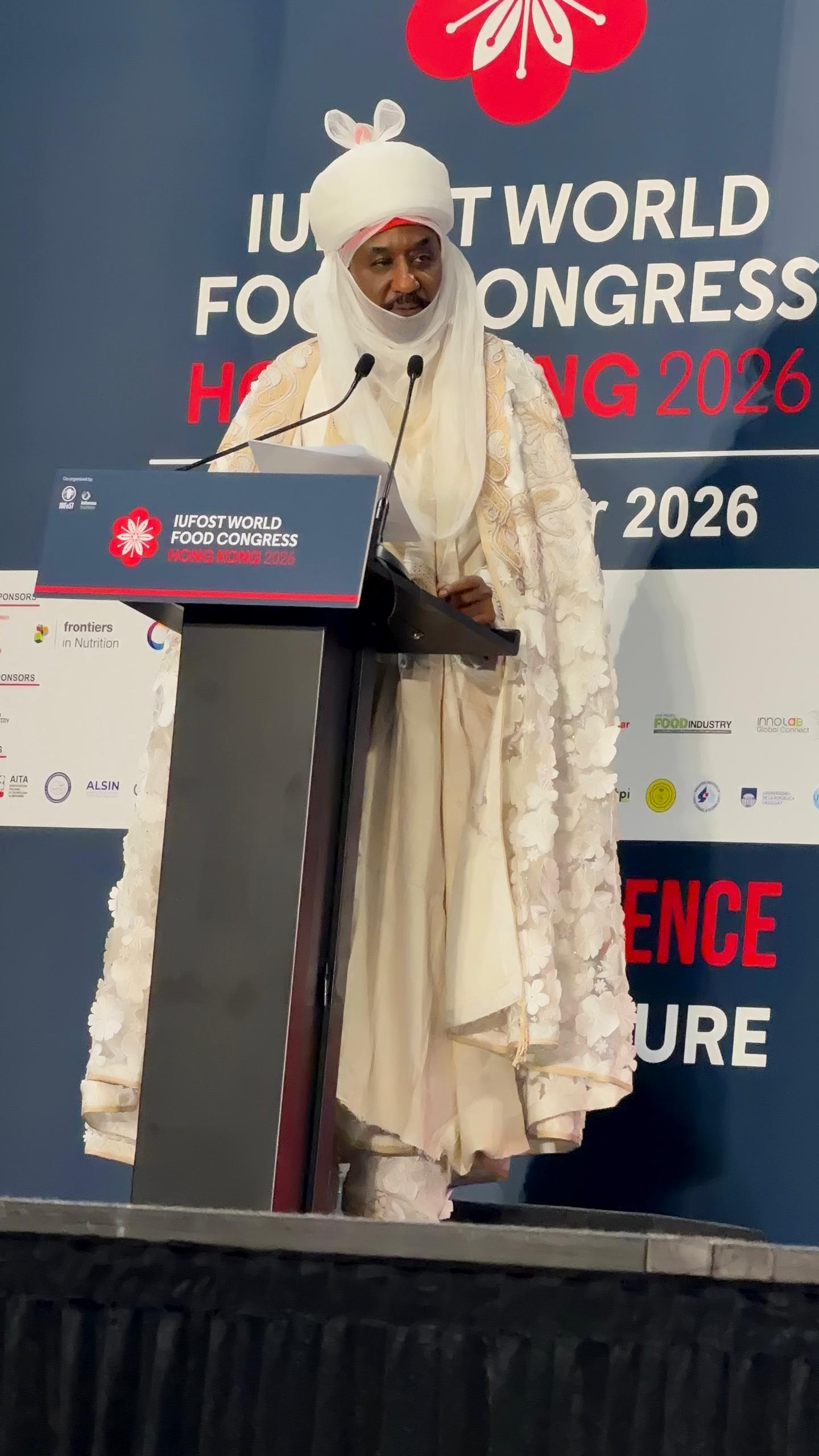
The Emir made the call in an address at the 23rd IUFoST World Food Congress, being held in Hong Kong from 25 to 29 October 2026. The monarch, who also serves as Chairman of the Board of Trustees of the Nutrition Society of Nigeria, said the major challenge facing the world was no longer simply a lack of knowledge, but the difficulty of delivering available solutions to the communities that need them most.

Glob Hub
Highlighting the scale of the crisis, the Emir referred to the 2026 State of Food Security and Nutrition in the World report, which indicated that the proportion of the global population experiencing hunger declined from 8.6 per cent in 2022 to 7.8 per cent in 2025. However, he warned that the progress remained insufficient, as millions of people continued to struggle to access nutritious food. United Nations estimates put the number of people facing hunger worldwide at approximately 645 million in 2025.
The Emir also drew attention to persistent food insecurity across Africa, where many people remain unable to afford or access nutritious diets because of economic pressures and other challenges. In Nigeria, humanitarian assessments projected that more than 34 million people would face acute food insecurity during the 2026 lean season, the period before new harvests become widely available.
According to the monarch, the global ambition to end hunger cannot be achieved through laboratory research alone, nor can traditional institutions resolve the challenge in isolation. He stressed the need to combine scientific knowledge with the experience and community networks of traditional institutions, which have long contributed to local food security. He cited traditional grain storage systems, known as Rumbu, as well as Zakat and Waqf, as established practices that could be strengthened through modern scientific approaches.
The Emir also recalled the contribution of traditional rulers to public awareness campaigns and efforts to build community trust during the fight against polio in northern Nigeria. He said the influence of traditional leaders could similarly help communicate nutrition messages and encourage better food practices, particularly in communities where they maintain close relationships with residents.

Glob Hub
To strengthen cooperation, the Emir proposed four key measures: involving traditional rulers in the planning of nutrition programmes; scientifically assessing traditional foods to establish their nutritional benefits; investing in community-based agriculture and local food production; and encouraging traditional councils to embrace food science and use it to raise public awareness.
He emphasised that the fight against hunger should not be viewed as a conflict between tradition and modernity, but as an opportunity to combine the strengths of both approaches to develop sustainable solutions. He also reaffirmed the Kano Emirate Council’s commitment to contributing to international efforts to ensure that everyone has access to adequate and nutritious food.
Khalil Ibrahim Yaro
Experienced journalist, Editor in Chief and media professional with a strong background in field reporting, investigative journalism, Editorial production, interviewing, research, digital media and newsroom coordination.
More from Khalil Ibrahim Yaro