The 84-year-old Kentucky senator returned to the U.S. Senate on Monday, September 14, as lawmakers resumed work following a five-week congressional recess.
His return marked his first public appearance at the Capitol since his health problems began in June and ended weeks of uncertainty over when he would be able to resume his legislative duties.
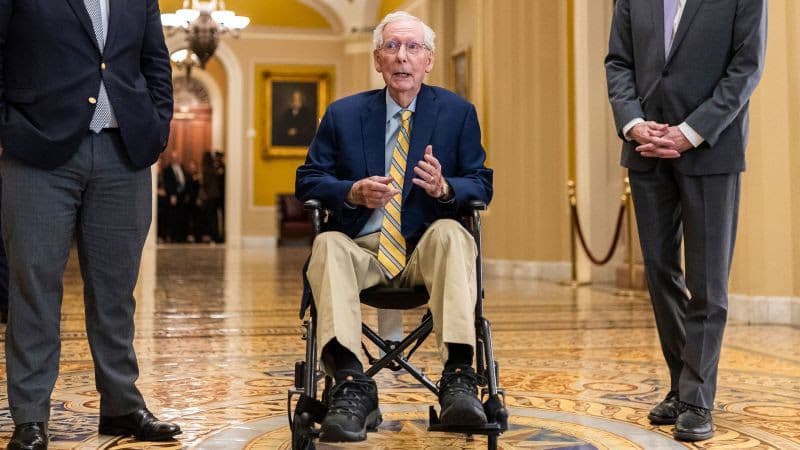
Speaking to reporters outside the Senate chamber, McConnell said he was ready to return to work and complete his responsibilities during the remaining months of his current term.
The veteran Republican senator acknowledged that he had not yet made a full recovery but said he had assured Senate Majority Leader John Thune that he would make every effort to be present for important votes.
McConnell had been largely out of public view since mid-June, when he was taken to a Washington-area hospital after falling at his home.
His office later disclosed that the fall had briefly left him unconscious.
During his hospitalization, McConnell also developed pneumonia and received treatment, including antibiotics, according to information released by his office and attributed to his attending physician.
After his hospital treatment, he was transferred to a rehabilitation facility, where he underwent intensive physical therapy.
He was discharged in early August and continued his recovery at home before eventually returning to the Senate.
The prolonged absence raised questions in Washington about McConnell’s health and whether he would be able to continue participating fully in Senate business.
The senator has experienced health and mobility challenges in recent years, including previous falls.
His medical history also includes childhood polio, which has been identified by the Capitol physician as a factor affecting his mobility.
Despite those challenges, McConnell continued communicating with his staff and colleagues while recovering and remained involved in political and legislative discussions.
His return is significant for the Senate because the chamber is closely divided and individual senators can play an important role in major votes.
The Senate currently has 53 Republicans and 47 Democrats, meaning the absence of even a single senator can become important when lawmakers face closely contested votes.
McConnell’s return therefore gives Republicans another experienced senator as Congress enters the final months of the current legislative session.
The Kentucky senator also remains one of the most influential figures in the modern history of the Republican Party.
He served as Senate Republican leader for many years and became the longest-serving Senate party leader in U.S. history.
Although he is approaching the end of his political career, McConnell has indicated that he intends to remain active and complete his current term.
He previously announced that he would not seek re-election and is expected to leave the Senate when his term expires in January 2027.
His return therefore comes during the final months of his more than four decades in the Senate.
During his first day back, McConnell indicated that he intended to work on several major issues.
Among the areas he highlighted were new farm legislation, strengthening the United States’ relationship with NATO and responding to Russian aggression against Ukraine.
Those issues come as Congress faces a busy legislative period ahead of the November midterm elections.
Lawmakers are expected to deal with major legislation, government funding questions, judicial nominations and other political issues before the current congressional session comes to an end.
McConnell’s participation could be particularly important in votes where the Republican majority requires the attendance of nearly all its members.
His absence during the summer had already affected the arithmetic surrounding some Senate votes.
His return could therefore provide Republican leaders with greater flexibility as they attempt to advance their legislative priorities.
McConnell also demonstrated his intention to resume his Senate responsibilities by participating in voting on a Republican judicial nominee following his return.
That move signalled that, despite continuing his recovery, he intends to remain engaged in the work of the chamber.
For McConnell, the return also represents a personal milestone following a difficult period of medical treatment and rehabilitation.
The senator has acknowledged that he is not completely recovered, meaning questions about how much of the Senate’s demanding schedule he can maintain are likely to continue.
At the same time, his appearance at the Capitol demonstrates his intention to remain politically active rather than spend the remainder of his term away from public duties.
McConnell’s health has been the subject of considerable public attention over the past several years, particularly because of his age and previous incidents involving falls and mobility difficulties.
His latest absence was therefore closely watched by both Republicans and Democrats.
But his return provides some immediate clarity: the veteran senator intends to continue serving until the end of his current term.
The next challenge will be balancing his legislative responsibilities with his ongoing physical recovery.
Senate Majority Leader John Thune and other Republican lawmakers will also be watching McConnell’s availability as the chamber moves into an important period of voting.
For Republicans, having McConnell back provides the experience of a senator who has spent decades shaping the Senate and playing a central role in major legislative and judicial battles.
For Democrats, his return means another Republican vote is available in a chamber where the balance of power can make individual attendance particularly significant.
McConnell’s return also comes as both parties prepare for the 2026 midterm elections, which will determine the political balance in Congress beyond the current session.
For now, however, the Kentucky senator’s immediate priority is completing the remaining work of his current term while continuing his recovery.
After roughly three months away from the Senate, Mitch McConnell is back on Capitol Hill.
His return does not remove questions about his long-term health, but it confirms his intention to remain active in the Senate and participate in the legislative process through the final months of his current term.
The veteran Republican will now turn his attention to the remaining legislative agenda, major votes and foreign-policy issues while continuing to recover from the health problems that kept him away from Washington for much of the summer.

Khalil Ibrahim Yaro
Experienced journalist, Editor in Chief and media professional with a strong background in field reporting, investigative journalism, Editorial production, interviewing, research, digital media and newsroom coordination.
More from Khalil Ibrahim Yaro