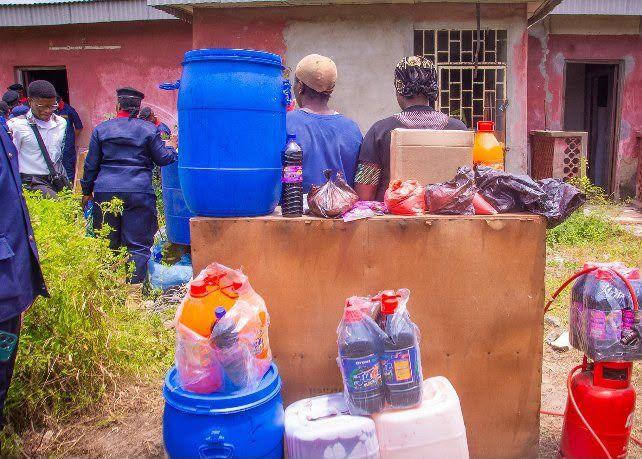
According to the NSCDC, the suspected production facility was uncovered in Aradagun, Badagry, following five days of surveillance conducted by its personnel in collaboration with a Nigerian Army camp in the area.
The agency said officers raided the facility between Saturday night, September 19, and Sunday morning, September 20, 2026, and arrested the two suspects at the location.

Glob Hub
The NSCDC said preliminary investigations indicated that the product was allegedly produced using water, artificial flavouring, industrial sweeteners, colouring agents and other chemicals, rather than fresh fruit.
The agency also alleged that the production was being carried out in conditions that did not meet appropriate food hygiene standards.
NSCDC said the product was allegedly being distributed to markets in Lagos, Benin City and other parts of Nigeria.
Items recovered during the operation reportedly included a vehicle, cartons of the suspected juice, processing equipment, chemicals, drums and a gas cylinder.
The agency also alleged that the suspects were using a NAFDAC registration number, 01-2166L, which it said was suspected to be invalid.

Glob Hub
However, the status of the registration should be confirmed independently by the National Agency for Food and Drug Administration and Control, NAFDAC, before it is treated as an established fact.
The Lagos State NSCDC Commandant, Adedotun Keshinro, said the facility had been shut down to prevent further production and distribution of the product.
He said investigations were continuing, with the NSCDC expected to work with NAFDAC and other relevant agencies before the suspects are taken to court in accordance with the law.
The operation has renewed attention on the production and distribution of food and beverage products without proper regulatory oversight and appropriate hygiene standards.
However, the information currently available represents allegations and preliminary findings from the authorities. There is no independent evidence in the available reports establishing that the product caused any specific illness.
Further testing by the relevant regulatory authorities will be important in determining the composition and safety of the seized products.

Khalil Ibrahim Yaro
Experienced journalist, Editor in Chief and media professional with a strong background in field reporting, investigative journalism, Editorial production, interviewing, research, digital media and newsroom coordination.
More from Khalil Ibrahim Yaro