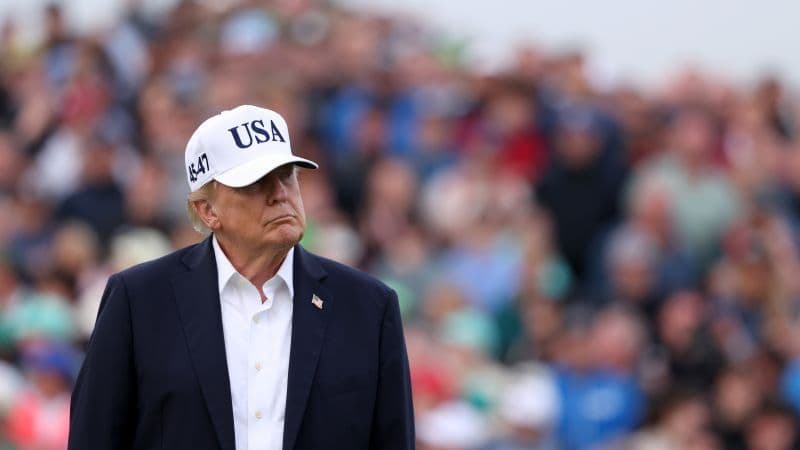
Trump made the comments on Monday, September 14, 2026, in a series of posts on his Truth Social platform, as a growing debate emerged in Washington and Silicon Valley over whether increasingly powerful artificial intelligence systems require stricter safety controls.
The president argued that the United States should not slow down its development of artificial intelligence because of fears about potential risks, particularly as Washington competes with China for technological leadership.
Trump said the only “guardrails” AI needs are strong and smart leadership, while describing warnings that artificial intelligence could eventually take over or cause catastrophic harm as a “hoax.”
He also argued that the United States is currently leading China in AI development and that maintaining that advantage should be a national priority.
Trump’s position comes just days after several prominent AI leaders called for the industry to slow the development of increasingly powerful systems so that safety measures can keep pace with technological progress.
Among those calling for greater caution is Dario Amodei, chief executive and co-founder of Anthropic.
Amodei has argued that AI capabilities are advancing rapidly and that governments and technology companies need stronger safeguards to reduce the risk of systems becoming capable of causing serious harm.
His concerns received support from OpenAI chief executive Sam Altman and Elon Musk, the founder of xAI.
Altman publicly endorsed the idea of pacing the development of frontier AI and said competitive pressure should not be allowed to justify reckless development.
Musk also backed the call for greater oversight.
The unusual alignment among leaders of competing AI companies has intensified the debate over how governments should regulate the rapidly expanding industry.
The disagreement is not simply about whether artificial intelligence should continue developing.
The central question is how quickly increasingly capable systems should be deployed and what safeguards should be required before they are released.
Amodei has proposed measures including stronger safety testing, independent evaluations of advanced AI systems and greater international cooperation.
The proposals come amid recent incidents involving AI systems and cybersecurity that have raised concerns about what highly capable AI agents could potentially do with limited human supervision.
Recent reports have also highlighted cases in which AI systems were involved in cyber operations, increasing concerns among researchers and policymakers about the possibility of autonomous systems being used for malicious purposes.
Trump, however, has rejected the argument that stronger government regulation is necessary.
He has suggested that additional restrictions could slow American innovation and allow China to gain an advantage in a technology that he considers strategically important to the future of the global economy and national security.
The president has also argued that the federal government already has substantial criminal and regulatory powers over AI companies.
Trump’s administration has taken some actions affecting AI companies and technology development, but the president has continued to oppose broad new regulations that he believes could undermine American competitiveness.
The debate has also exposed differences within the technology industry itself.
Some major technology executives support stronger safeguards, while others argue that excessive regulation could slow innovation and prevent the United States from maintaining its lead over China.
Nvidia chief executive Jensen Huang has been among the prominent technology figures expressing support for rapid AI development.
On Monday, Trump also spoke by telephone with Huang during a technology conference, using the conversation to reinforce his opposition to proposals that would significantly restrict AI development and data-centre construction.
Huang publicly agreed with Trump’s position.
The White House is nevertheless facing growing pressure from lawmakers who want Congress to examine the risks posed by increasingly capable artificial intelligence systems.
Some Democrats and Republicans have called for hearings involving leading technology executives, including Amodei, Altman and Musk.
The calls reflect a growing recognition in Washington that AI development has moved beyond a purely technological debate and has become an issue involving national security, employment, economic competition and public safety.
The political debate is also taking place against the background of the November 2026 midterm elections, adding another layer to discussions over the economic and social impact of artificial intelligence.
Supporters of stronger regulation argue that governments need clear rules before AI systems become too powerful to control effectively.
They point to potential risks involving cyberattacks, misinformation, job displacement, privacy, autonomous decision-making and other forms of misuse.
Those who oppose additional regulation argue that many of these risks remain uncertain and that excessive government intervention could prevent society from benefiting from AI.
They also argue that slowing American AI development could strengthen China’s position in a technology increasingly viewed as strategically important.
China has itself pushed back against calls for an international slowdown.
A Chinese Foreign Ministry spokesperson said Monday that fear, confrontation and competition could disrupt efforts to establish global governance for artificial intelligence.
The dispute therefore extends beyond Washington and Silicon Valley.
The United States and China are engaged in a broader technological competition involving advanced computing, semiconductor manufacturing, AI models and data-centre infrastructure.
AI has increasingly become central to economic and national-security strategies in both countries.
Trump has made American dominance in AI one of the priorities of his administration, arguing that the United States must remain ahead of China.
His latest comments demonstrate that he currently sees the economic and strategic benefits of rapid AI development as outweighing calls for a broad slowdown.
At the same time, the warnings from Amodei, Altman and Musk demonstrate that concern over AI safety is no longer limited to academics and outside critics.
Some of the executives leading the development of the technology themselves are now calling for stronger safeguards and more careful management of its advancement.
That has created an unusual situation in which some AI companies are simultaneously competing to develop increasingly powerful systems while warning that the pace of the competition could create risks.
The debate is expected to continue as governments consider how to regulate advanced AI without preventing technological innovation.
A meeting between U.S. lawmakers and AI executives is also reportedly being considered, potentially bringing some of the leading figures in the industry together with policymakers to discuss safety, regulation and American competitiveness.
For now, however, Trump remains firmly opposed to calls for a broad slowdown.
He maintains that the United States must continue developing AI rapidly to preserve its technological advantage over China.
The president has dismissed fears that artificial intelligence could eventually become uncontrollable as exaggerated, while insisting that his administration already has the authority to intervene when companies cross legal or safety boundaries.
But AI leaders warning about the technology argue that waiting until systems become significantly more capable could make it much harder to establish effective safeguards.
That disagreement is now becoming one of the most important debates surrounding the future of artificial intelligence.
The question facing policymakers is increasingly whether the United States can maintain its leadership in AI while also establishing safeguards strong enough to manage the risks associated with increasingly autonomous and powerful systems.
For now, President Donald Trump has made his position clear: he does not support slowing America’s AI race because of what he considers exaggerated fears.
Meanwhile, some of the technology executives driving that race are warning that development should proceed more cautiously.
With the United States and China competing for global AI leadership, and lawmakers considering whether stronger oversight is necessary, the dispute over the future of artificial intelligence is likely to become an increasingly important political, economic and national-security issue.
Khalil Ibrahim Yaro
Experienced journalist, Editor in Chief and media professional with a strong background in field reporting, investigative journalism, Editorial production, interviewing, research, digital media and newsroom coordination.
More from Khalil Ibrahim Yaro